The rules, from UDC 11-3C-4
Meridian's Unified Development Code sets residential parking rules in section 11-3C-4. Paraphrased:
- Street yard: the area between the house and the street can hold registered cars and motorcycles plus one other vehicle. That one can be an RV or a trailer with current registration, or one boat or off-highway vehicle.
- Weight: vehicles with a gross vehicle weight rating of 16,000 pounds or more can't park in the street yard.
- Sidewalks: parked vehicles can't hang over any sidewalk or the public right-of-way. A long trailer in a short driveway is the classic violation.
- Side yard: if no RV, boat or trailer is in the street yard, one can be parked in a side yard that isn't screened by a solid fence.
- Everything else: additional RVs, boats and trailers go in the rear or side yard behind a 6-foot solid fence.
- Drainage: parking areas have to drain so surface water doesn't run onto neighbors or walkways.
- Living in it: RVs and trailers can't be used as living quarters outside an approved RV park (UDC 11-3A-20).
What it has to park on
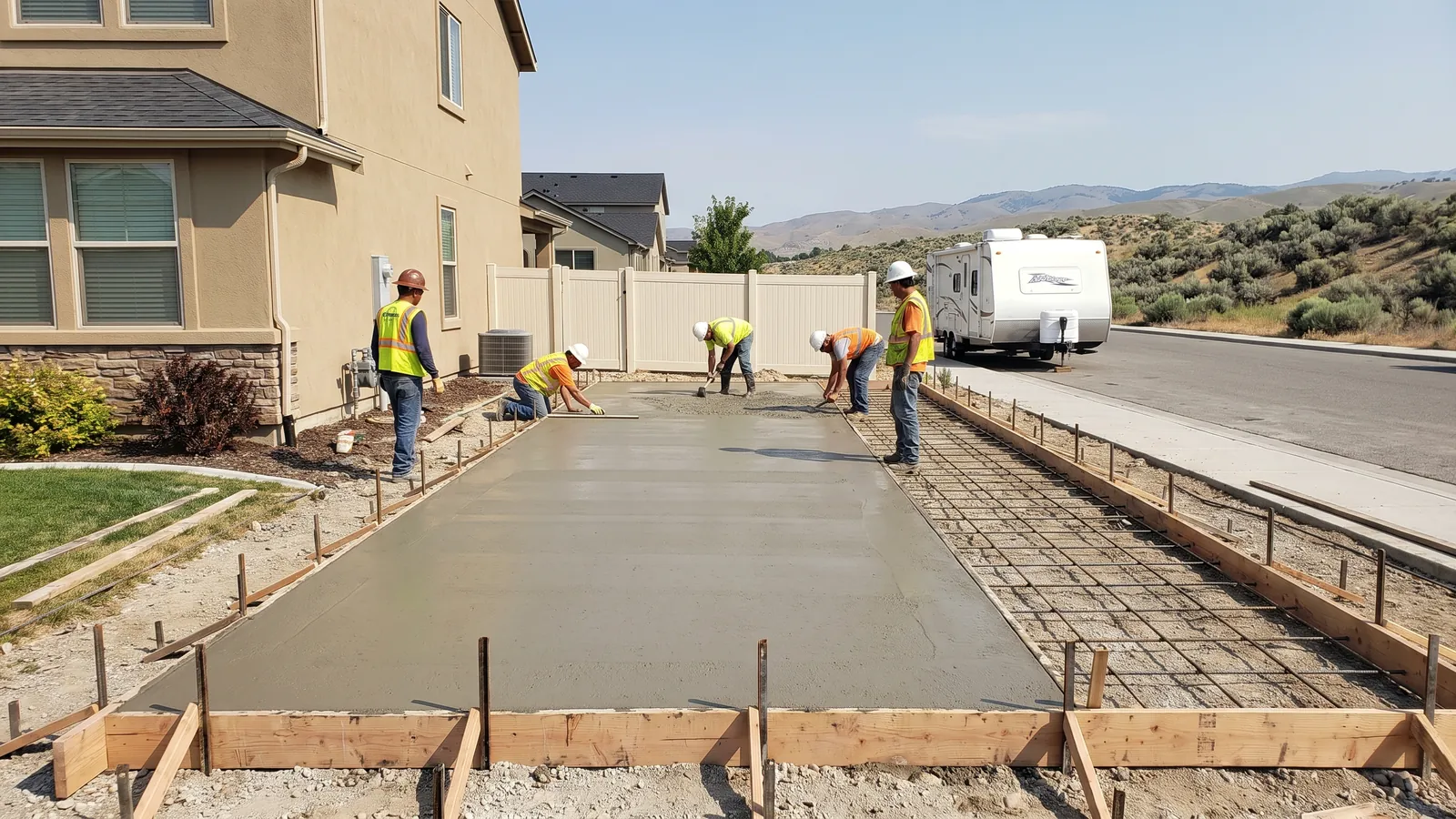
Section 11-3C-4.B requires off-street parking in the street yard, and the driveways to it, to be built on a compacted gravel base at least 4 inches thick, surfaced with concrete or asphalt. No vehicle may be parked in the required street yard on any other surface. So a trailer on the lawn or on gravel next to the driveway in front of the house doesn't comply. The usual fix is a concrete pad beside the driveway. Behind a fence in the side or rear yard, the surface rule for the street yard doesn't apply the same way, but a pad still keeps a trailer from sinking into wet ground and keeps weeds out from under it.
Permits
The City's "Do I Need a Permit?" handout lists an RV concrete pad as a project that doesn't need a building permit. If the pad needs a new or wider curb cut or approach, that work is in ACHD's right-of-way and needs ACHD's permit and a bonded contractor. Your HOA is the other approval. Many Meridian covenants limit RVs more strictly than the City, for example by limiting how long one can sit in a driveway or requiring it behind a fence. Check your CC&Rs before you plan the pad.
Planning the pad
- Length: the RV's length plus about 2 feet at each end, and room to open doors and slides.
- Width: 12 feet is typical. Side-yard pads are often limited by the side setback, commonly 5 feet in Meridian's R-4 and R-8 districts, and by utility easements along the lot line.
- Thickness: six inches with rebar for a motorhome or a heavy fifth wheel; five inches is enough for a light trailer or boat. Leveling jacks crack thin pads.
- Access: measure the swing a trailer needs to get past the house corner, the air conditioner and the gate.
- Irrigation: side and back lot lines often carry the pressurized irrigation line. Locate it before digging.
- Drainage: slope the pad away from the house and off the neighbor's lot, as the code requires.
What it costs
A 12-by-40 six-inch reinforced pad runs about $5,200 to $7,400 in 2026. A 12-by-50 is about $6,500 to $9,200. A 10-by-20 extra parking pad, the size Meridian's code accepts as a non-garage parking space, is about $2,200 to $3,200. See RV pads for the full price table.
Common questions
Can I park my RV in the driveway in Meridian?
One RV or trailer with current registration is allowed in the street yard, under 16,000 pounds GVWR, as long as it doesn't overhang the sidewalk. Your HOA may be stricter.
Can I park a trailer on gravel beside the house?
Not in the required street yard. The code requires concrete or asphalt over at least 4 inches of compacted gravel there. In a fenced side or rear yard, gravel may be allowed, but a pad holds up better.
Do I need a permit for an RV pad?
Not a City building permit. ACHD's permit applies only if you change the curb cut or approach.
Can I live in my RV on the pad?
Not outside an approved RV park, under UDC 11-3A-20.
Related: RV pads · Concrete driveways · Permit guide · Approaches and sidewalks